PCB TOOLS / Electronics reference
HDMI Pinout: Type A, Mini, Micro and Legacy Type B
Compare the 19-contact HDMI Type A/C/D mappings with legacy 29-contact Type B. Look up TMDS, DDC, CEC, hot-plug detection and auxiliary power, with preserved grouped headings and visible HEAC-polarity and power-limit clarifications.
Quick answer
Standard HDMI Type A has 19 contacts: DDC clock is 15, DDC data 16, +5 V 18 and HPD 19. Mini Type C also has 19, with DDC ground at 13. Micro Type D puts HPD at 1 and +5 V at 19. Do not reuse one connector type’s pin numbers on another.
Scope
This is a legacy TMDS lookup including the uncommon Type B dual-link definition. Its 29 rows compare connector types; an ordinary HDMI connector does not have 29 contacts. Modern FRL reuses high-speed pairs, and ARC/eARC, HEAC and cable power have separate requirements. This page is not a replacement for the applicable HDMI specification or device data sheet. Functional diagrams do not establish a solder-side, plug-face or mirrored mechanical view.
Reading example
For a Type A to Micro Type D cable, Type A DDC clock/data 15/16 map to Type D 17/18. Type A +5 V contact 18 maps to Type D 19, while Type A HPD 19 maps to Type D 1. Establish connector type and the data sheet’s viewing direction before checking functional continuity with power removed.
Checked reference tables
| Signal | Type A | Type C (Mini) | Type D (Micro) |
|---|---|---|---|
| SCL | 15 | 15 | 17 |
| SDA | 16 | 16 | 18 |
| CEC | 13 | 14 | 15 |
| DDC/CEC ground | 17 | 13 | 16 |
| +5 V | 18 | 18 | 19 |
| HPD / HEAC− | 19 | 19 | 1 |
| Utility / HEAC+ | 14 | 17 | 2 |
Legacy tables with visible corrections
High-Definition Multimedia Interface
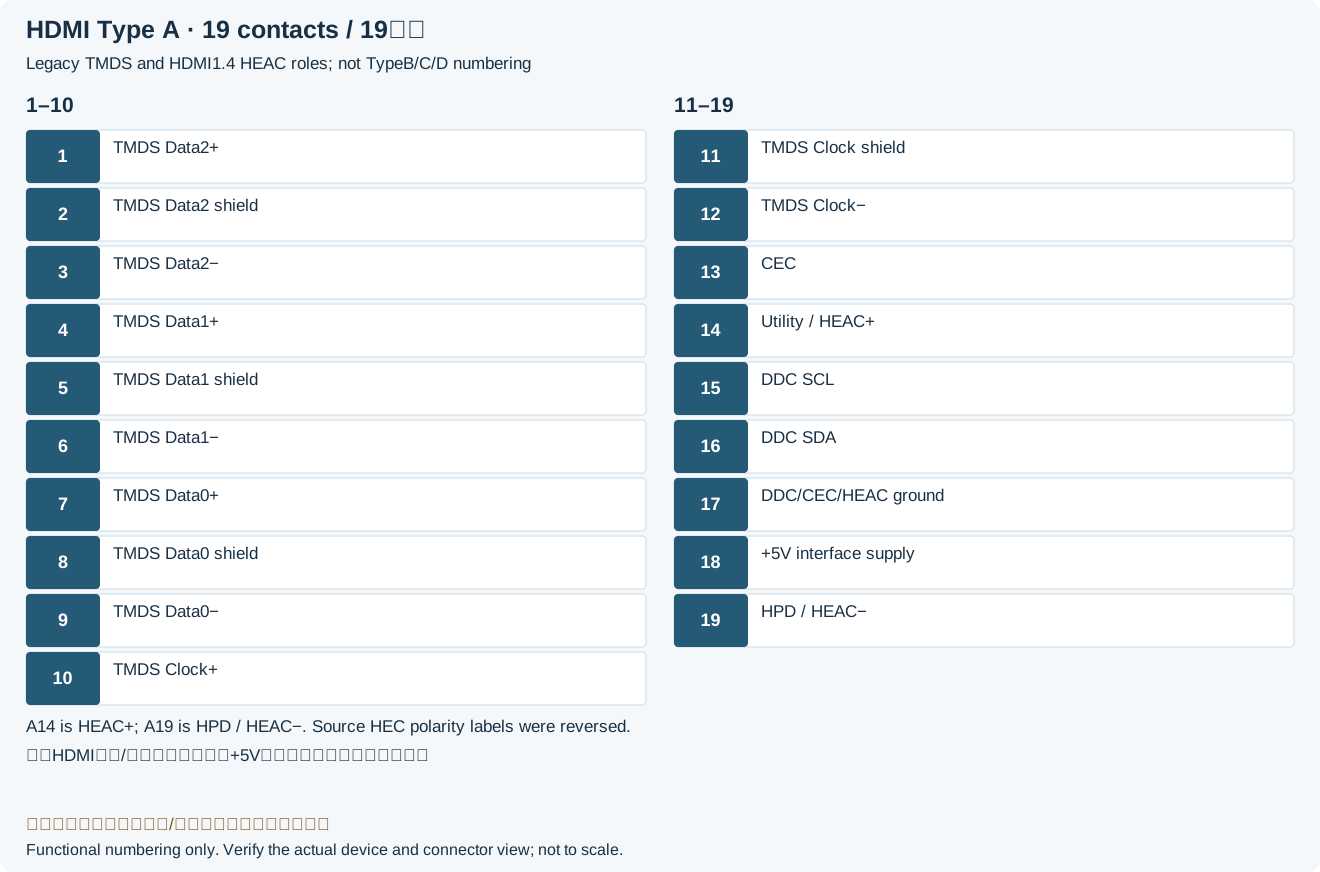
| Pin | Description | |||
|---|---|---|---|---|
| Type A (standard) | Type B | Type C (mini) | Type D (micro) | |
| 1 | 1 | 2 | 3 | TMDS Data2+ |
| 2 | 2 | 1 | 4 | TMDS Data2 Shield |
| 3 | 3 | 3 | 5 | TMDS Data2– |
| 4 | 4 | 5 | 6 | TMDS Data1+ |
| 5 | 5 | 4 | 7 | TMDS Data1 Shield |
| 6 | 6 | 6 | 8 | TMDS Data1– |
| 7 | 7 | 8 | 9 | TMDS Data0+ |
| 8 | 8 | 7 | 10 | TMDS Data0 Shield |
| 9 | 9 | 9 | 11 | TMDS Data0– |
| 10 | 10 | 11 | 12 | TMDS Clock+ |
| 11 | 11 | 10 | 13 | TMDS Clock Shield |
| 12 | 12 | 12 | 14 | TMDS Clock– |
| 13 | TMDS Data5+ | |||
| 14 | TMDS Data5 Shield | |||
| 15 | TMDS Data5– | |||
| 16 | TMDS Data4+ | |||
| 17 | TMDS Data4 Shield | |||
| 18 | TMDS Data4– | |||
| 19 | TMDS Data3+ | |||
| 20 | TMDS Data3 Shield | |||
| 21 | TMDS Data3– | |||
| 13 | 22 | 14 | 15 | CEC |
| 14 | 23 | 17 | 2 | A/C/D: Utility/HEAC+ (reserved in early versions); Type B: legacy reservedLegacy record: “Reserved (HDMI 1.0-1.3c); HEC Data- (HDMI 1.4+ with Ethernet)”. Do not reuse the source HEC Data− wording as HEAC polarity. Wilder Table 4 identifies Micro D contact 2 as Utility/HEAC+, corresponding to A14 and C17. |
| 24 | Reserved | |||
| 15 | 25 | 15 | 17 | SCL (I²C Serial Clock for DDC) |
| 16 | 26 | 16 | 18 | SDA (I²C Serial Data for DDC) |
| 17 | 27 | 13 | 16 | DDC/CEC ground; HEAC shield reference where applicableLegacy record: “DDC/CEC/HEC Ground”. The auxiliary-channel shield/ground is not an independent HEC data signal; Wilder identifies DDC/CEC Ground. |
| 18 | 28 | 18 | 19 | +5 V auxiliary power; verify current against the applicable specification and deviceLegacy record: “+5V Power (max 50 mA)”. The source 50 mA does not identify revision or source/sink scope. TI Rev. C and optional HDMI Cable Power use different conditions, explained above. |
| 19 | 29 | 19 | 1 | HPD; A/C/D also uses HEAC− in applicable HEAC modesLegacy record: “Hot Plug Detect (All versions); HEC Data+ (HDMI 1.4+ with Ethernet)”. The source HEC Data+ is not the HEAC polarity here. Wilder Table 4 assigns Micro D contact 1 to HPD/HEAC−, corresponding to A19 and C19. |
Legacy source notes and applicability
These notes retain the legacy record. For corrected facts and applicability, use this page’s quick answer, scope and visible table corrections.
Type A HDMI is electrically compatible with the single-link DVI-D. This means that a DVI source can drive an HDMI monitor, or vice versa, by means of a suitable adapter or cable.
Frequently asked questions
Are Mini and Micro HDMI only smaller shells?
Both normally have 19 contacts, but numbering differs. Micro contact 1 is HPD, whereas Type A contact 1 is TMDS Data2+. Identical contact numbers are not a wiring map.
Is Type B in this table USB Type-B?
No. It means legacy 29-contact dual-link HDMI Type B, unrelated to USB connectors or USB power. Standard HDMI is Type A; use its own column.
Can the +5 V contact power any active cable or device?
No. Check the source, sink and active-cable requirements. The 300 mA Cable Power feature requires support at both ends of that power arrangement and is not a default promise from an ordinary port.
Related tools and references
Sources and verification
- Wilder: HDMI Type-C HEAC manual, Table 4 Mini assignments and polarity
- Wilder: HDMI Type-D HEAC manual, Table 4 contact map and polarity
- Texas Instruments: HDMI 5 V supply requirements and protection, Rev. C
- HDMI: optional Cable Power support conditions and 300 mA scope
- Dell: 19-contact Standard, Mini and Micro HDMI connector types
Legacy baseline: the Electrodoc Pro 5.2 data package. Raw records are retained and checked factual corrections are shown explicitly.