PCB TOOLS / Electronics reference
Switch Contacts: SPST/SPDT/DPST/DPDT and Crossover
Look up poles, throws, changeover and crossover connections. Distinguish topology from NO/NC and center-off behavior. Original symbols explain connectivity, not IEC certification or universal terminal layout.
Quick answer
Pole counts independent circuits controlled by one operation; throw counts selectable paths per pole. SPDT is one pole/two throws and DPDT two poles/two throws. These names alone do not promise center-off, momentary return or break-before-make.
Scope
The source conflates changeover and centre-off in SPCO/DPCO; confirm manufacturer usage separately. Shared SPDT art across source rows does not make SPTT or center-off identical. The intermediate/crossover example shows straight/cross connections only. Current, AC/DC load class, sequencing and terminal numbering remain device-specific.
Reading example
For 1 SPDT using this diagram’s functional labels, position A connects common C to terminal 1 and position B connects C to terminal 2. These are not a product’s physical terminal numbers. A DPDT straight/cross selector needs 2 linked poles and a defined wiring scheme; its name alone does not guarantee a short-free transition. Motor reversal also requires suitable load ratings and contact sequencing.
Legacy tables with visible corrections
| Abbreviation | Description | Symbol | IEC |
|---|---|---|---|
| SPST | Single pole, single throw | 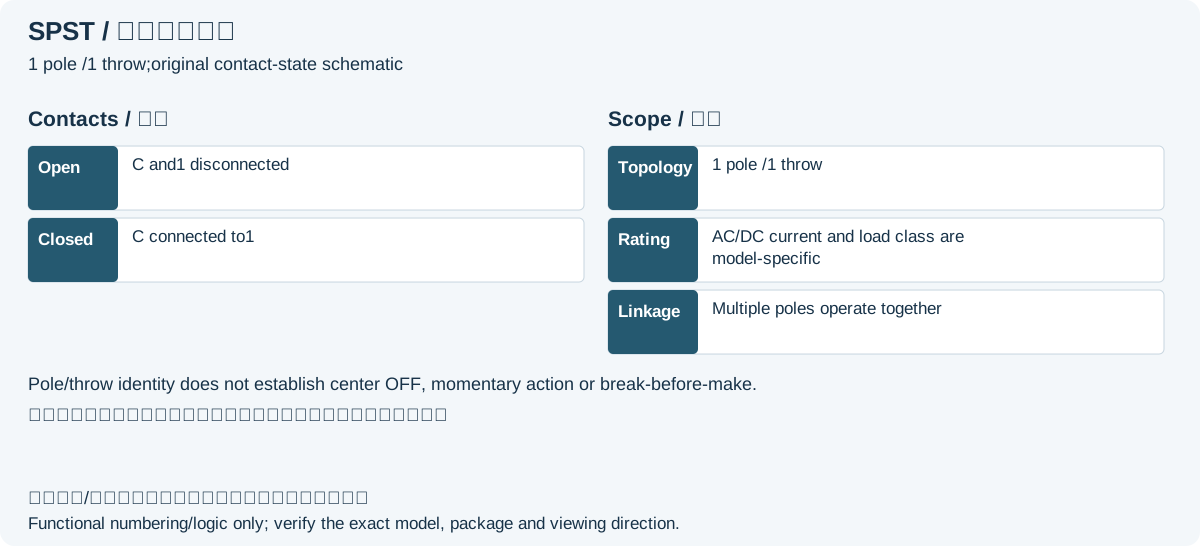 | 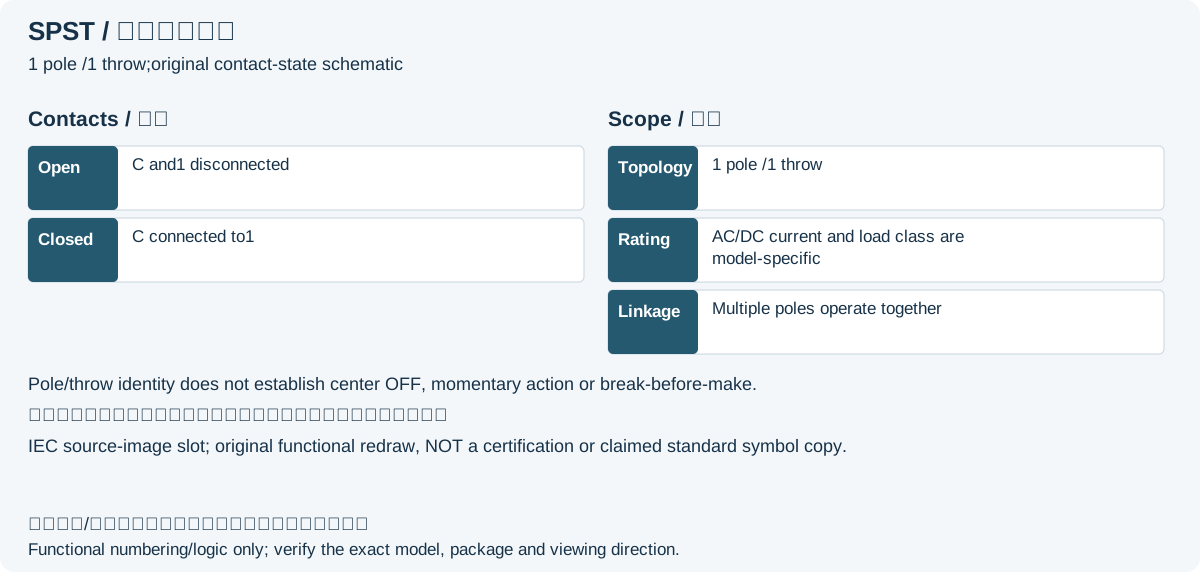 |
| SPDT | Single pole, double throw | 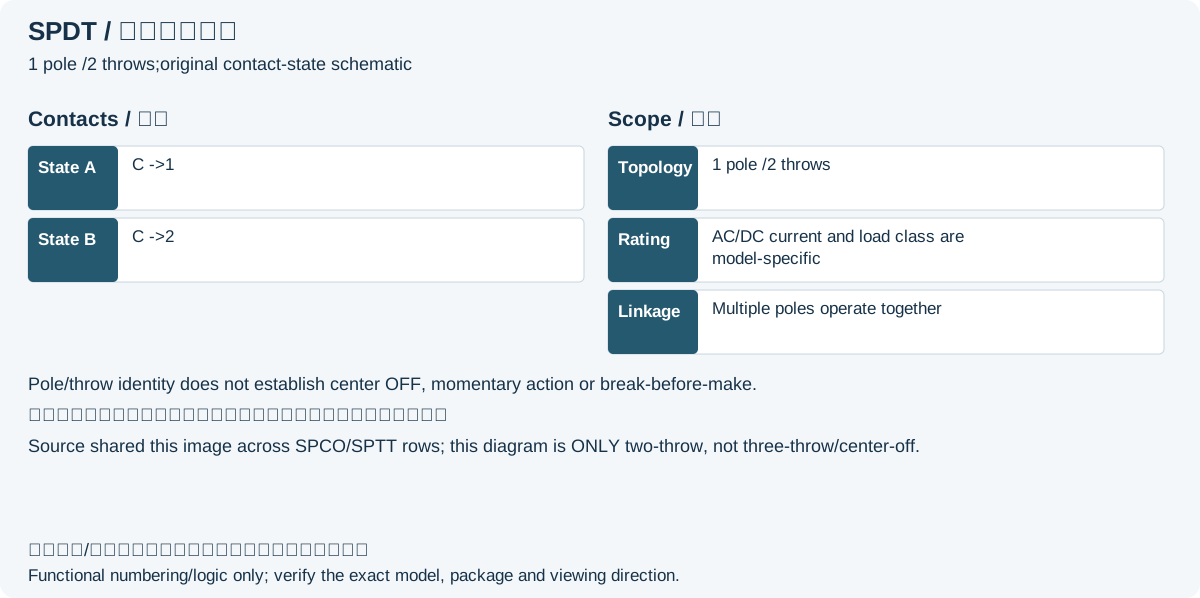 | 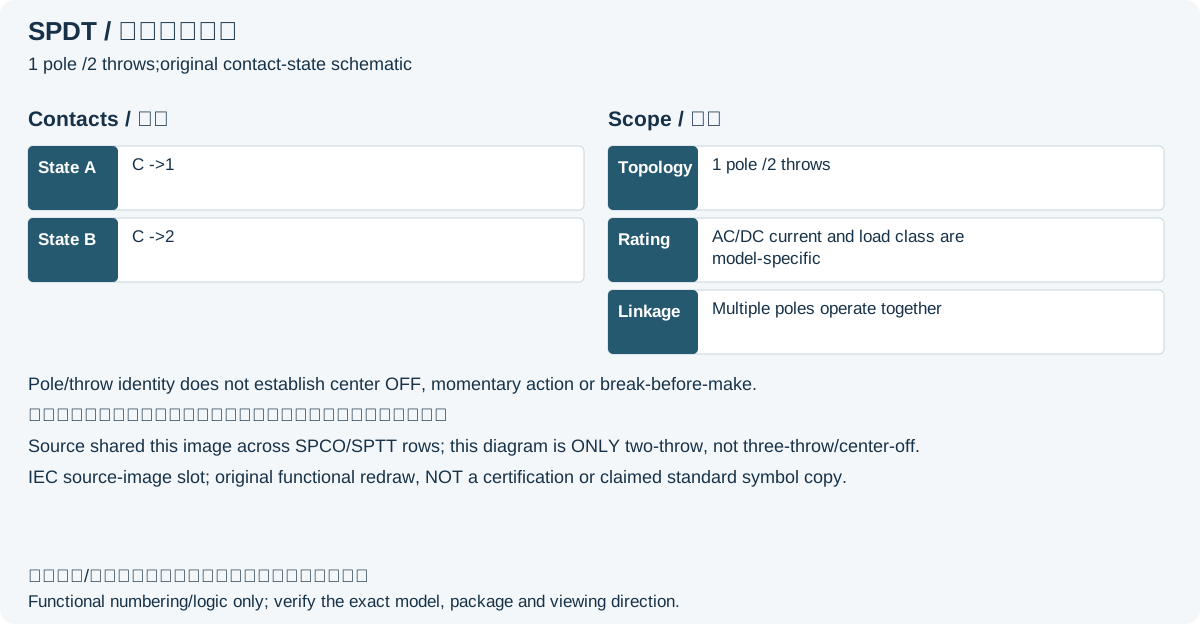 |
| SPCO | Single-pole changeover; center-off requires the exact model, not the abbreviation aloneLegacy record: “Single pole changeover or Single pole, centre off”. The source conflates changeover with center OFF; one does not imply the other. | ||
| SPTT | Single Pole, Triple Throw | ||
| DPST | Double pole, single throw | 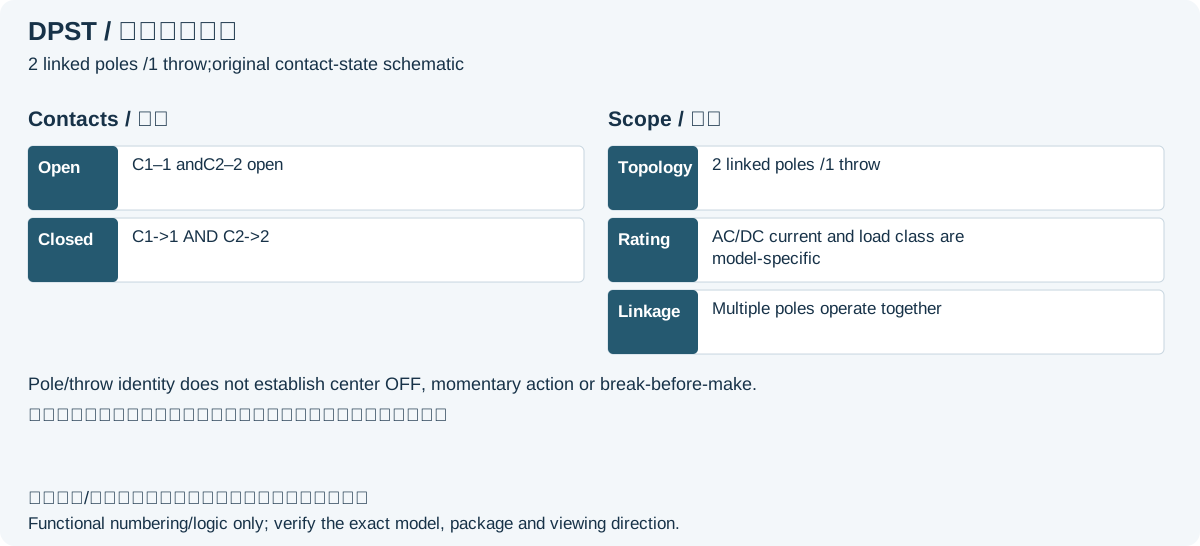 | 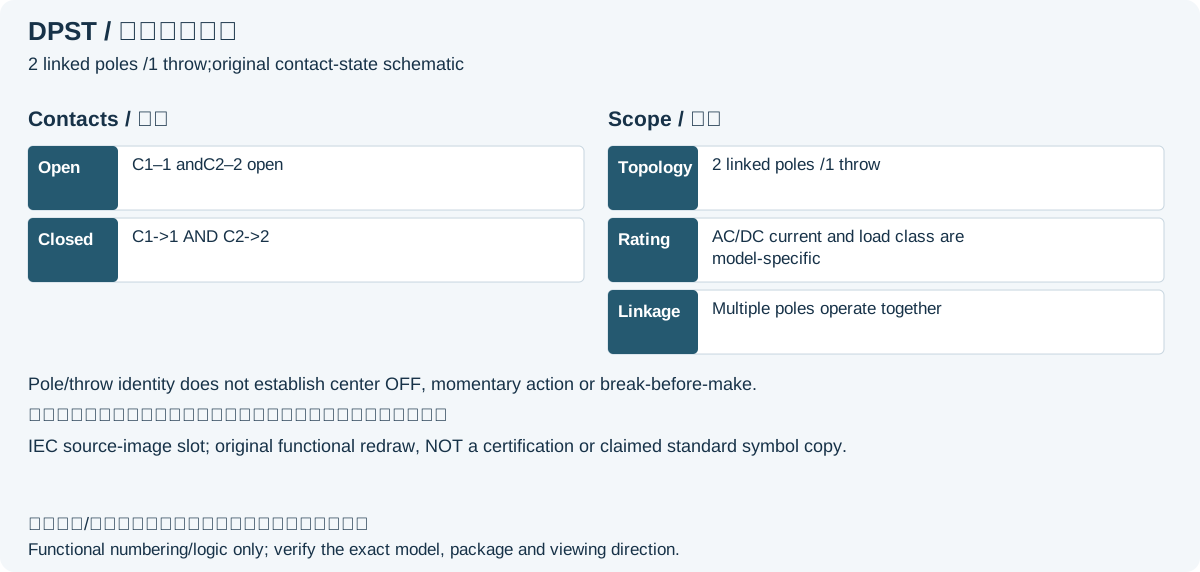 |
| DPDT | Double pole, double throw | 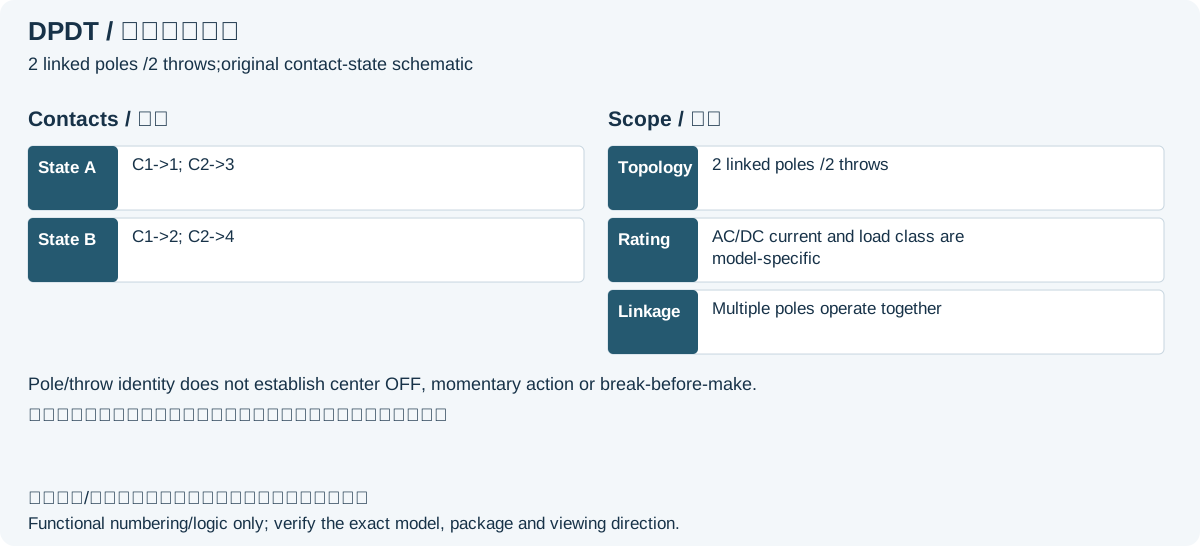 | 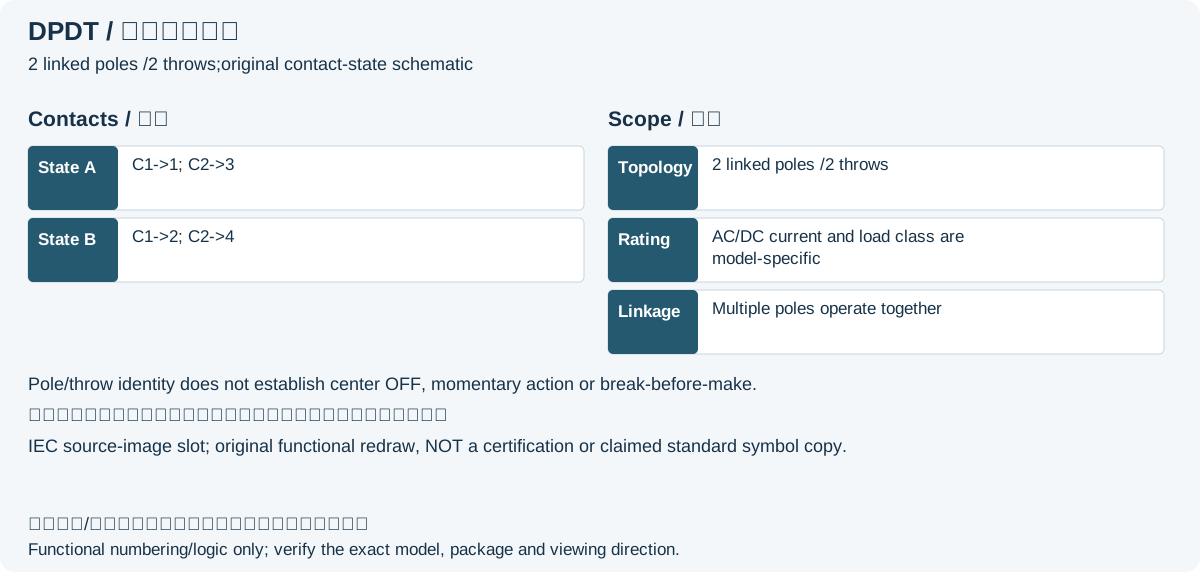 |
| DPCO | Double-pole changeover; center-off is model-specificLegacy record: “Double pole changeover or Double pole, centre off”. DPCO alone does not establish ON-OFF-ON or transition sequencing. | ||
| Intermediate switch | DPDT switch internally wired for polarity-reversal applications | 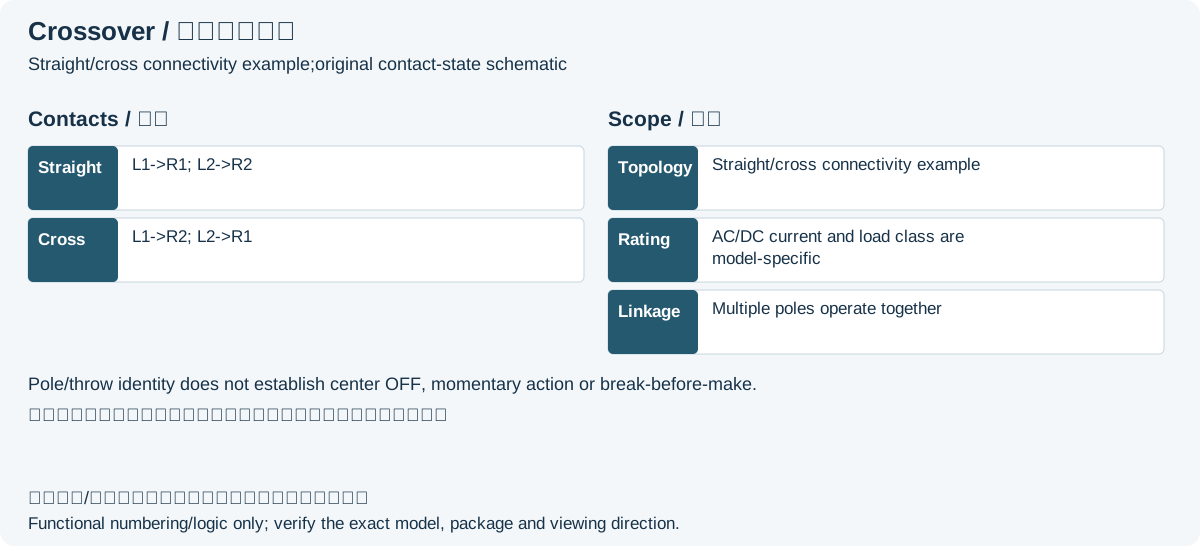 |
Frequently asked questions
Are NO/NC the same as throw count?
No. NO/NC describes the unactuated state; poles/throws describe circuits and paths. SPDT can provide NO and NC paths.
Are two poles two independent controls?
Their circuits can be separate, but actuation is normally linked. Pole states are not independently selected, and insulation ratings still matter.
Related tools and references
Sources and verification
Legacy baseline: the Electrodoc Pro 5.2 data package. Raw records are retained and checked factual corrections are shown explicitly.