PCB TOOLS / Electronics reference
SIM and Smart-Card Contacts: C1–C8 and Form Factors
Look up contact SIM/UICC power, reset, clock, I/O and optional contacts, plus1FF–4FF/MFF2 sizes. Distinguish legacy VPP, SWP/AUX roles and the eSIM provisioning concept.
Quick answer
Core contacts are C1 VCC, C2 RST, C3 CLK, C5 GND and C7 I/O. C4/C8/C6 depend on revision and interface support; C6 is not a universal external programming-voltage input. Nano-SIM is nominally12.3×8.8×0.67 mm;6×5 mm is a common MFF2 example, not the size of every eSIM.
Scope
The contact diagram is a functional contact-card map, not every socket footprint or eSIM chip ball map. UICC voltage classes depend on card/terminal capability, not a universal5 V supply. eSIM/eUICC describes functionality and provisioning, with multiple removable or soldered forms. Use the actual standard for tolerances and corner geometry.
Reading example
Micro-SIM is15×12×0.76 mm and Nano12.3×8.8×0.67 mm. Reducing card size does not redefine C1/C5/C7. An adapter must still meet socket contact, thickness and terminal requirements.
Legacy tables with visible corrections
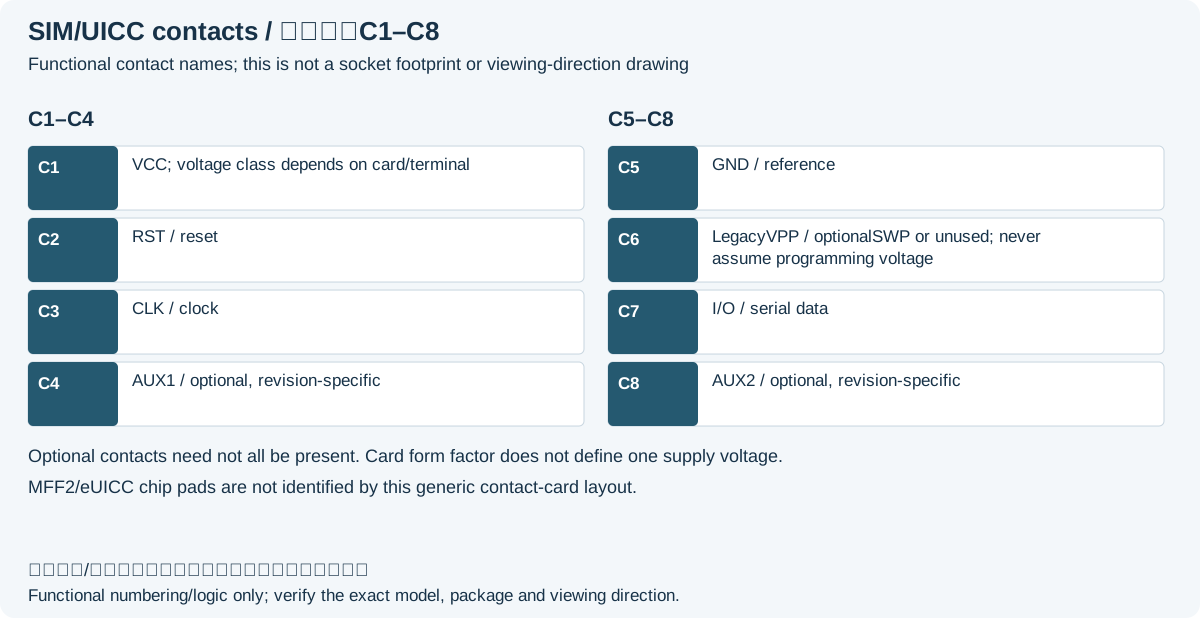
| Pin | Signal | Description |
|---|---|---|
| C1 | VCC | VDC power supply input |
| C2 | RESET | Reset signal. Supplied from the interface device or in combination with an internal control circuit |
| C3 | CLOCK | Clock signal for serial data |
| C4 | RESERVED | AUX1 (optional) |
| C5 | GND | Ground |
| C6 | VPP | Legacy VPP / optional extension contact; modern UICC may use SWP or leave it unusedLegacy record: “Programming voltage input (optional). Required to program the internal non-volatile memory”. Do not generalize legacy programming-voltage wording to all modern UICCs. |
| C7 | DATA | I/O for serial data |
| C8 | RESERVED | AUX2 (optional) |
SIM card sizes
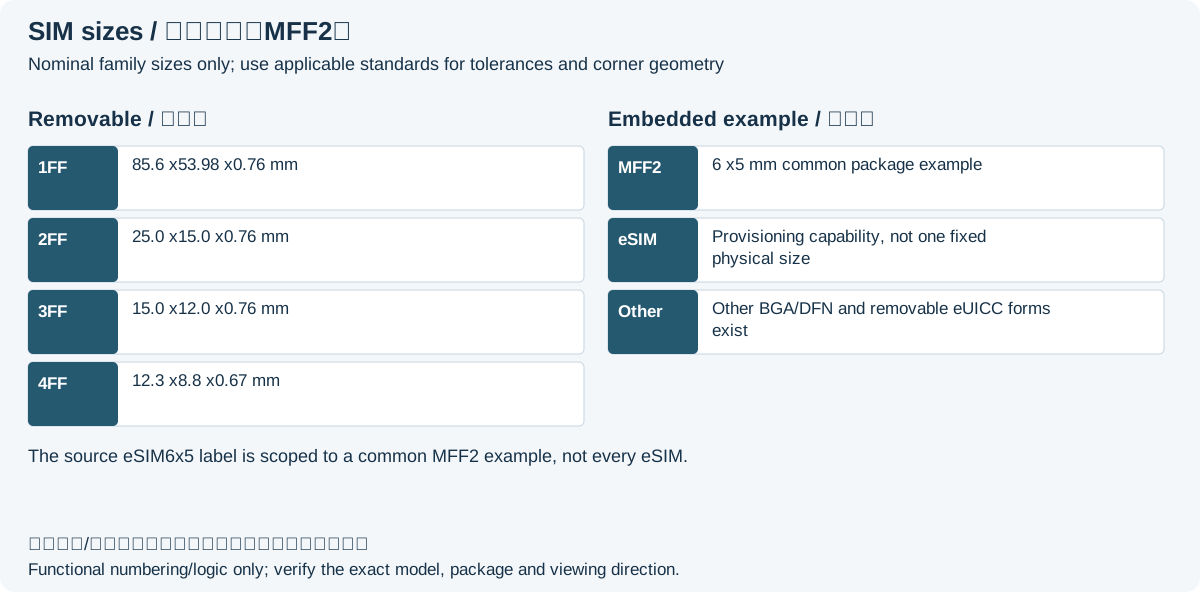
| SIM card | Standard reference | Length (mm) | Width (mm) | Thickness (mm) |
|---|---|---|---|---|
| Full-size (1FF) | ISO/IEC 7810:2003, ID-1 | 85.6 | 53.98 | 0.76 |
| Mini-SIM (2FF) | ISO/IEC 7810:2003, ID-000 | 25.0 | 15.0 | 0.76 |
| Micro-SIM (3FF) | ETSI TS 102 221 V9.0.0, Mini-UICC | 15.0 | 12.0 | 0.76 |
| Nano-SIM (4FF) | ETSI TS 102 221 V11.0.0 | 12.3 | 8.8 | 0.67 |
| MFF2 soldered-package example (often used for eUICC)Legacy record: “eSIM (Embedded-SIM)”. eSIM/eUICC has no single physical size; GSMA lists MFF2, BGA and other forms. | JEDEC Design Guide 4.8, SON-8, ETSI TS 103 383 V12.0.0, GSMA SGP.22 V1.0 | 6.0 | 5.0 | <1 |
Legacy source notes and applicability
These notes retain the legacy record. For corrected facts and applicability, use this page’s quick answer, scope and visible table corrections.
SIM card sizes
Frequently asked questions
Does every SIM require eight contacts?
No. Optional contacts may be absent. Check the card/terminal specification; C labels are not universal socket package pin numbers.
Is eSIM one fixed-size chip?
No. Remote provisioning and physical packaging are separate; MFF2 is one common soldered form.
Related tools and references
Sources and verification
- ETSI TS102221: UICC contacts, voltage classes and4FF dimensions
- GSMA: multiple SIM/eSIM form-factor examples
Legacy baseline: the Electrodoc Pro 5.2 data package. Raw records are retained and checked factual corrections are shown explicitly.