PCB TOOLS / Electronics reference
Thermocouple Wire Colors and Polarity: IEC, ANSI and Legacy BS
Look up thermocouple conductor polarity, extension-wire jacket colors and legacy codes. Distinguish extension from compensating cable, with visible corrections to the source color graphic, Type S range and interval-average coefficient.
Quick answer
Identify type, color-code standard and cable grade before polarity. Type K is normally green positive/white negative under IEC, yellow positive/red negative under ANSI, and brown positive/blue negative with a red jacket under legacy BS1843. Color coding and the instrument’s thermocouple-type setting are separate checks.
Scope
IEC60584-3 addresses identification and tolerances of industrial extension and compensating cables. BS1843 is retained for installed legacy equipment. Jacket examples below cover ordinary extension/compensating cable; ANSI thermocouple-grade brown jackets, intrinsically-safe blue jackets and uncolored high-temperature insulation are distinct cases. Reference-function temperature coverage is not a continuous rating for a probe, jacket, connector or cable.
Reading example
For the IEC Type K example connect green to + and white to −; an ANSI-coded Type K instead uses yellow + and red −. The source K value is an interval average: 41.276mV from 0°C to1000°C divided by1000°C gives41.276µV/°C. It is not a constant for converting temperatures across the full range.
Checked reference tables
| Type | Color scheme | Positive+ | Negative− | Jacket |
|---|---|---|---|---|
| K | IEC60584-3 | green | white | green |
| J | IEC60584-3 | black | white | black |
| N | IEC60584-3 | pink | white | pink |
| R | IEC60584-3 | orange | white | orange |
| S | IEC60584-3 | orange | white | orange |
| T | IEC60584-3 | brown | white | brown |
| E | IEC60584-3 | violet | white | violet |
| B | IEC60584-3 | grey | white | grey |
| K | ANSI extension/compensating | yellow | red | yellow |
| J | ANSI extension/compensating | white | red | black |
| N | ANSI extension/compensating | orange | red | orange |
| R | ANSI extension/compensating | black | red | green |
| S | ANSI extension/compensating | black | red | green |
| T | ANSI extension/compensating | blue | red | blue |
| E | ANSI extension/compensating | violet | red | violet |
| B | ANSI extension/compensating | grey | red | grey |
| K | BS1843 legacy | brown | blue | red |
| J | BS1843 legacy | yellow | blue | black |
| N | BS1843 legacy | orange | blue | orange |
| R | BS1843 legacy | white | blue | green |
| S | BS1843 legacy | white | blue | green |
| T | BS1843 legacy | white | blue | blue |
| E | BS1843 legacy | brown | blue | brown |
Legacy tables with visible corrections
| Type | Wire | Temp. Range (°C) | Sensitivity (μV/°C) | |
|---|---|---|---|---|
| T- | T+ | |||
| K | Alumel | Chromel | -270 to +1372 | 41.276 (0°C to +1000°C) |
| J | Constantan | Iron | -210 to +1200 | 57.953 (0→1000°C interval average, µV/°C)Legacy record: “57.953 (0°C to +750°C)”. J reference EMF at1000°C is57.953mV; the original0→750°C interval label does not match. |
| N | Nisil | Nicrosil | -270 to + 1300 | 36.256 (0°C to +1000°C) |
| R | Platinum | Platinum - 13% Rhodium | -50 to +1768 | 10.506 (0°C to +1000°C) |
| S | Platinum | Platinum - 10% Rhodium | −50 to +1768Legacy record: “+50 to +1768”. Type S ITS-90 reference functions extend to−50°C; this still is not a continuous cable rating. | 9.587 (0°C to +1000°C) |
| T | Constantan | Copper | -270 to +400 | 52.18 (0°C to +400°C) |
| E | Constantan | Chromel | -270 to +1000 | 76.373 (0°C to +1000°C) |
| B | Platinum - 6% Rhodium | Platinum - 30% Rhodium | ||
| Type | IEC Color | BS Color | ANSI Color |
|---|---|---|---|
| K | 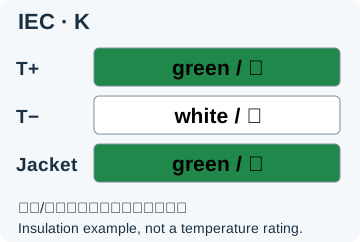 | 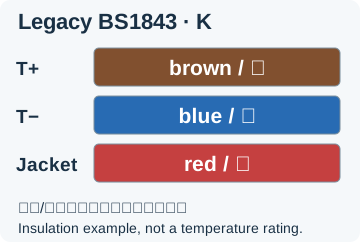 | 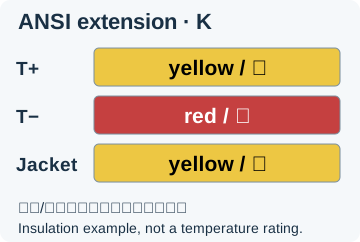 |
| J | 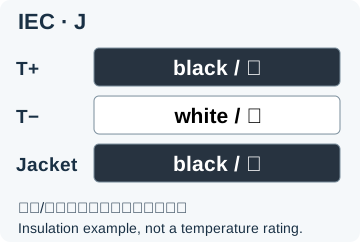 | 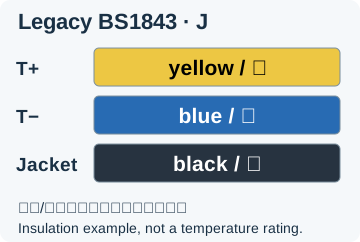 | 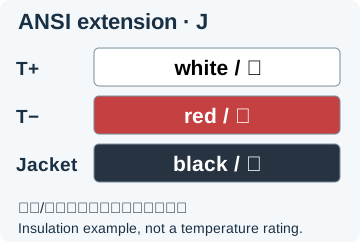 |
| N | 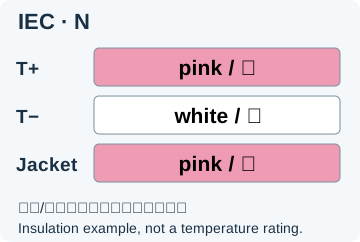 | 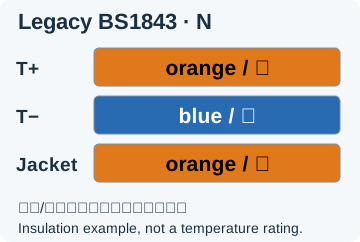 | 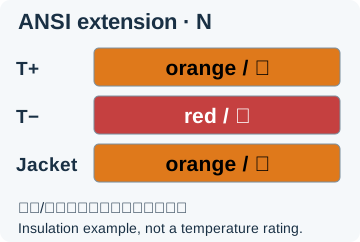 |
| R | IEC R: orange+ / white−; ordinary jacket orange. Adjacent legacy BS-N graphic was reused incorrectly.Legacy record: “”. The same source graphic also represents BS N; its blue negative must not be read as IEC R. See the checked color table. | 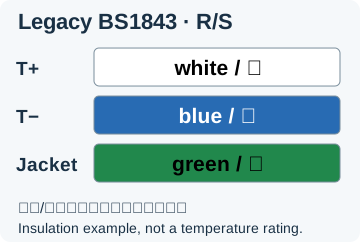 | ANSI R/S compensating cable: black+ / red−; jacket greenLegacy record: “n.d.”. Source n.d. omitted R/S compensating-cable colors; these alloys are not the noble-metal measuring legs. |
| S | IEC S: orange+ / white−; ordinary jacket orangeLegacy record: “n.d.”. Source n.d. is missing table data, not absence of an IEC definition. | | ANSI R/S compensating cable: black+ / red−; jacket greenLegacy record: “n.d.”. Source n.d. omitted R/S compensating-cable colors; these alloys are not the noble-metal measuring legs. |
| T | 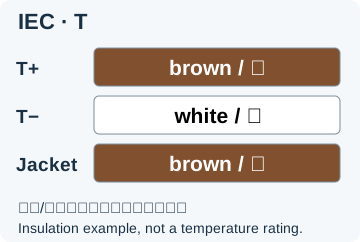 | 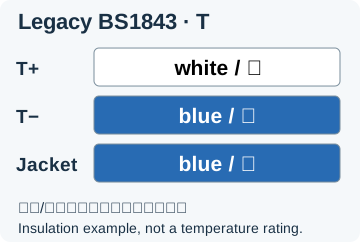 | 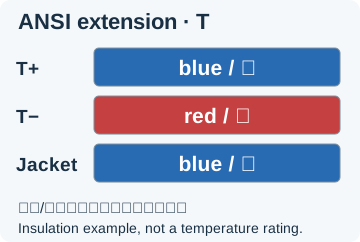 |
| E | 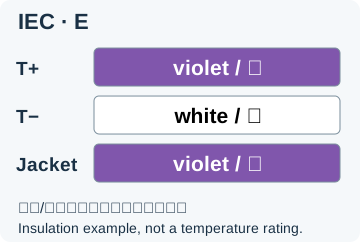 | 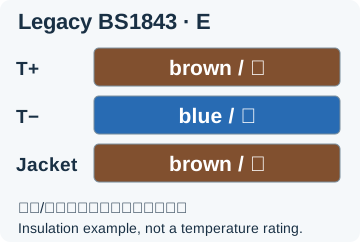 | 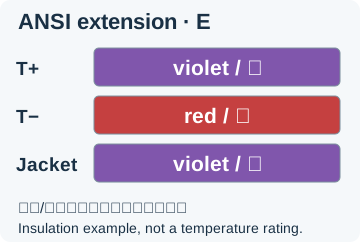 |
Frequently asked questions
Is red always positive?
No. ANSI normally uses red for negative; IEC normally uses white for negative. Older national schemes differ. Check the marked standard, cable designation and alloys first.
Are KX, KCA and KCB interchangeable?
No. KX is extension grade; KCA/KCB use different compensating alloy combinations and cable-temperature/error limits. Use the specified product and IEC60584-3 class, not the measuring-junction range.
Does a color standard change the thermocouple type?
No. An IEC-coded K and an ANSI-coded K are both Type K. Match actual alloys, polarity, connectors and the instrument’s K setting. Color is identification, not an electrical verification.
Why not use one fixed µV/°C value?
Thermocouple EMF is nonlinear and measured voltage depends on the reference-junction temperature. An interval-average slope is not the local differential sensitivity dE/dT.
Related tools and references
Sources and verification
- IEC60584-3:2021: extension/compensating-cable scope
- TC Ltd: colors, legacy schemes and cable grades
- Kjaerulf Pedersen: polarity and jackets by scheme
- NIST: ITS-90 reference-function database
- Texas Instruments: nonlinearity and cold-junction compensation
- Omega: Type J reference EMF table
Legacy baseline: the Electrodoc Pro 5.2 data package. Raw records are retained and checked factual corrections are shown explicitly.